
The complete buyer’s guide to commercial lighting:
How to source the right LED fixtures at the best wholesale price
A practical resource for retailers, contractors, distributors and project developers — covering product selection, key specs, and bulk sourcing strategy.
LED ceiling lights Downlights & spotlights Wall lights Pendant lights Solar lights Table lamps
Table of contents
- Why wrong lighting costs more than you think
- Matching fixture types to commercial spaces
- Decoding LED specs: CCT, CRI, lumens & IP
- 7 proven tactics to cut bulk sourcing costs
- Sourcing strategy by buyer type
- Common mistakes and how to avoid them
1. Why wrong lighting costs more than you think
Many procurement managers focus on unit price alone — and that’s where expensive mistakes begin. The upfront cost of a lighting product typically represents only 15–20% of its total lifecycle cost. The rest is electricity, maintenance, and the inevitable cost of getting it wrong.
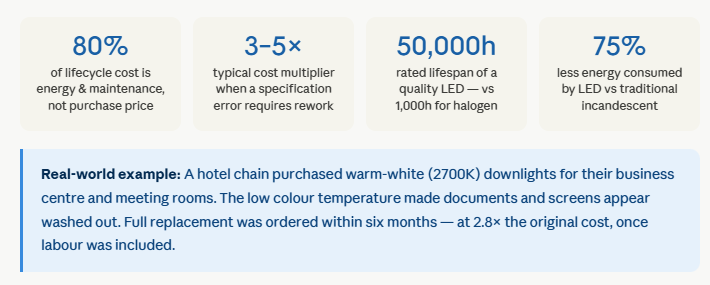
Real-world example: A hotel chain purchased warm-white (2700K) downlights for their business centre and meeting rooms. The low colour temperature made documents and screens appear washed out. Full replacement was ordered within six months — at 2.8× the original cost, once labour was included.
A solid specification decision considers four things simultaneously: the functional requirements of the space, fixture lifespan, installation and maintenance ease, and compatibility with existing electrical infrastructure.
2. Matching fixture types to commercial spaces
Not every fixture works in every setting. Here is a quick-reference matrix across the most common commercial environments.
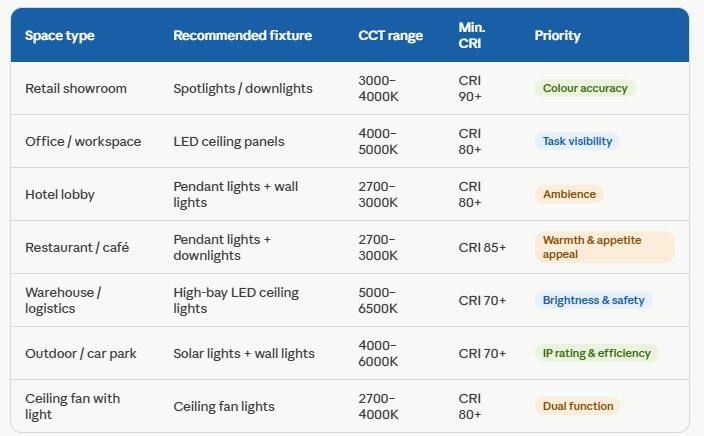
Watch out: Mixing colour temperatures across adjacent spaces (e.g. 3000K in a corridor, 5000K in meeting rooms) creates a jarring visual transition that customers and guests notice immediately. Plan your CCT scheme building-wide before ordering.
3. Decoding LED specs: CCT, CRI, lumens & IP rating
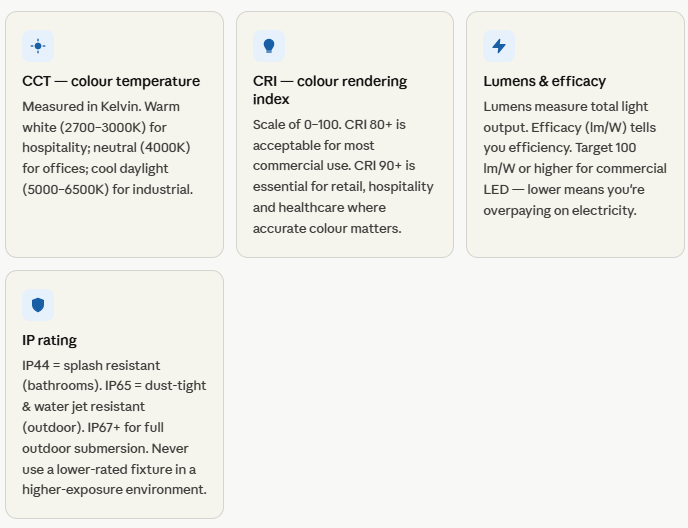
Lighting spec sheets can be intimidating. Here are the four numbers that actually matter for commercial procurement.
Quick lumen guide by application
| Application | Recommended lux level | Typical fixture wattage |
|---|---|---|
| Office workplane | 400–500 lux | 24–40W panel |
| Retail floor / display | 750–1000 lux | 7–15W spotlight |
| Hotel room / corridor | 100–200 lux | 5–10W downlight |
| Restaurant dining | 150–300 lux | 5–10W pendant |
| Warehouse aisle | 200–300 lux | 80–200W high-bay |
| Outdoor pathway | 20–50 lux | 10–30W solar / wall light |
4. Seven proven tactics to cut bulk sourcing costs
Working with a reliable wholesale LED lighting supplier means
you can negotiate better terms as your volume grows.
Whether you are stocking a warehouse or procuring for a 200-room hotel fit-out, these tactics consistently deliver 15–40% savings without compromising specification quality.
- Bundle product lines in a single order. Ordering LED ceiling lights, downlights and wall lights from the same wholesale supplier in one shipment reduces per-unit freight costs significantly and often unlocks tiered pricing discounts.
- Standardise on two or three SKUs per category. Limiting the number of fixture models you use simplifies spare stock management, speeds up installation, and gives you more volume leverage per SKU when negotiating price.
- Specify wattage realistically — don’t over-engineer. Many buyers over-specify luminous flux for “safety.” A 10W downlight delivering 900lm in a 3m-ceiling retail corridor does not need upgrading to 15W. Correct lux calculations before you order.
- Request samples before committing to large volumes. Always test a physical sample in situ before placing a bulk order. Colour consistency (SDCM ≤3), flicker rating, and dimmer compatibility are near-impossible to verify from a spec sheet alone.
- Negotiate payment and lead-time terms together. EXW or FOB pricing with a 30% deposit and 70% against B/L is standard. If you are a repeat buyer, use your order history to negotiate net-30 or net-60 terms.
- Plan for replacement stock upfront. For projects exceeding 500 units, hold 3–5% additional inventory on-site. Production batch variations (colour binning drift) make it difficult to source matched replacements 12 months later.
- Ask for certification documentation proactively. CE, RoHS, and for solar products IEC 62133 — insist on these before payment rather than at customs clearance. Missing certificates are the single largest source of order delays in B2B lighting imports.
5. Sourcing strategy by buyer type
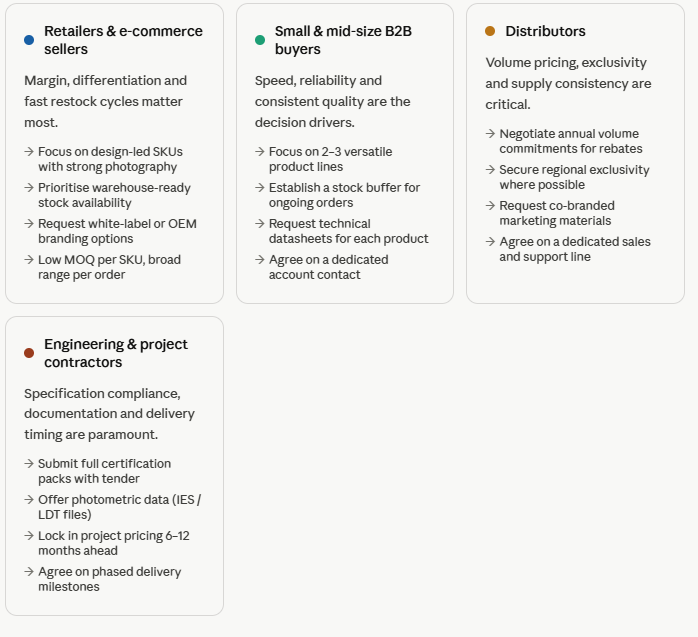
Different buyers have fundamentally different priorities. Here is how to approach your sourcing based on your business model.
Retailers & e-commerce sellers
6. Common mistakes — and how to avoid them
- Ordering by wattage, not lumens. Wattage only tells you power consumption. Two 10W fixtures from different manufacturers can deliver 700lm and 950lm respectively. Always compare lumen output and efficacy (lm/W).
- Ignoring dimmer compatibility. Not all LED downlights and pendant lights are dimmable. Even those labelled “dimmable” may flicker or drop-out below 30% with certain TRIAC dimmers. Always test before specifying at scale.
- Assuming outdoor = IP44. IP44 protects against water splashes — it does not handle driving rain, hose-down cleaning or submersion. Outdoor fixtures require IP65 as a minimum in most commercial applications.
- Selecting solar lights based on panel wattage alone. Battery capacity (Wh), discharge depth, and local peak sun hours determine real-world performance. A 20W panel with a 10Wh battery will underperform a 10W panel with a 30Wh battery in a cloudy climate.
- Specifying colour temperature without seeing a physical sample. 4000K from one manufacturer can appear noticeably different from 4000K from another due to variation in phosphor binning. Standardise your CCT across a single supply source.
- Skipping the light loss factor in quantity calculations. Lumen depreciation over time (typically 0.7–0.85 LLF) means your design needs more initial lumens than the maintained target. Failing to account for this leaves clients dissatisfied at year 3.
Home Glow Lamps is a trusted wholesale LED lighting supplier
shipping to retailers and contractors worldwide.
Ready to source? Talk to our wholesale team.
Home Glow Lamps supplies LED ceiling lights, downlights, wall lights, pendant lights, ceiling fan lights, table lamps and solar lights to retailers, distributors and project contractors worldwide. Request a quote or product catalogue today.Request a wholesale quote ↗
LED wholesale Commercial lighting Downlights Pendant lights Solar lights Bulk lightingsupply Lighting contractorguide CCTcolourtemperature CRI lighting